AI for RAN: Cutting the Bill Without Cutting the Network
Here is an outrageous thought - AI can be a champion for the good!
That sounds almost suspicious today.
After all, the dominant conversation around AI is not exactly cheerful. We hear about power-hungry tokens, vanishing jobs, collapsing business models, and data centres that seem to drink electricity for breakfast. Against that backdrop, is it not worth highlighting something genuinely sanguine about AI?
Of course, this article is a teaser to our upcoming report “AI in RAN – The ultimate bill-killer”. Make no mistake.
Before that, let’s dive into some philosophy.
What is creation? What is destruction? What is creative destruction? And what, for that matter, is destructive creation?
No, no, no. My hinges aren’t coming off. Hopefully.
But the onslaught of AI on everything is nothing like what we have ever seen so far. t is not merely another technology wave. It is rewriting assumptions across industries, business models, skills, infrastructure, and even energy economics.
But let us stick to telecom.
Make it more focused – cellular telephony.
Even sharper – the RAN.
What is AI doing with the RAN – AI-on-RAN, or AI-and-RAN, or AI for RAN? Where do these combinations fit in the aforementioned matrix of creation and destruction?
Let us declutter. Stick to AI for RAN. Being telecom market research analysts, our primary focus is and has to be the RAN. How is AI being useful to the RAN?
For one – power savings!
As kids, we were taught – knowledge is power. In today’s day and age, this dictum should read – reliable power (read electricity) is the gateway to gaining greater knowledge, greater insights and well, greater power (electricity and everything else).
AI is quietly embellishing cellular operators with juicy power savings in the most power-guzzling component of their networks – the RAN.
Insight Research goes right into the heart of the matter. Just how much power savings can AI accrue for the RAN?
To answer that, we must first ask another question.
Why does the RAN need so much power in the first place?
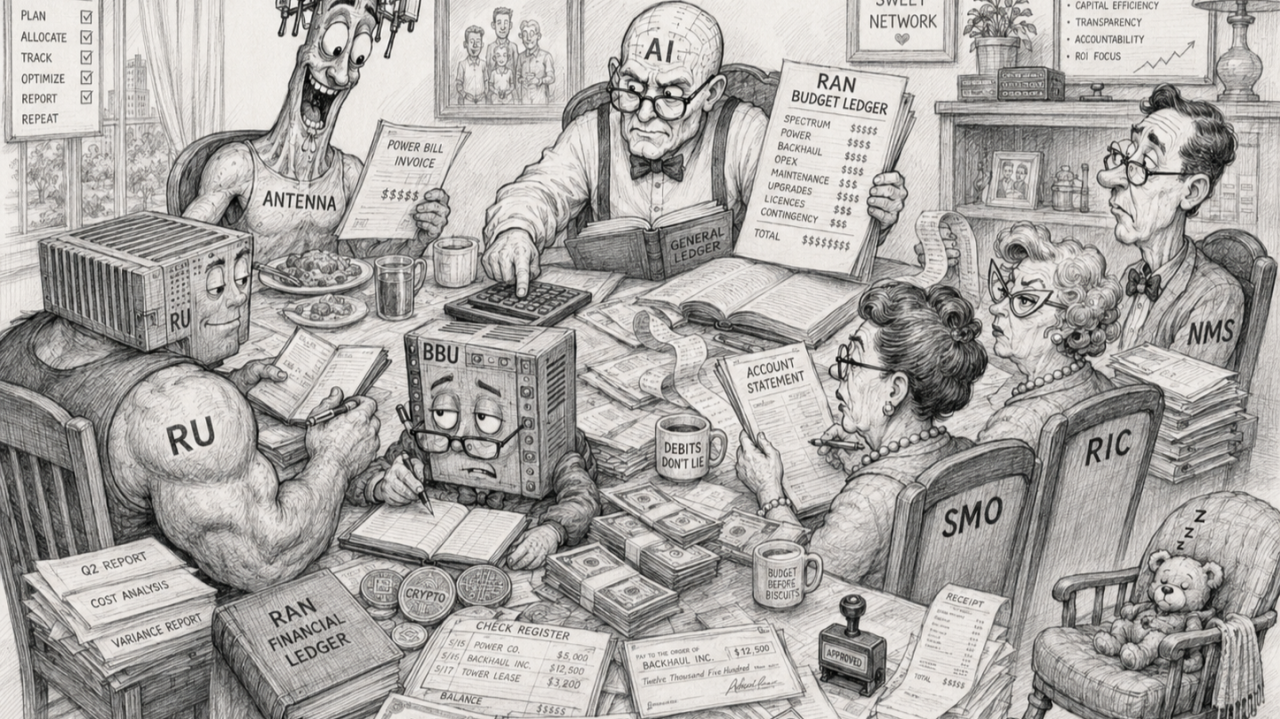
That is because, the RAN is like a family. Like every family, it has family members. Consequently, the RAN has mouths to feed, literally!
What are these mouths?
The antenna. The radio unit. The baseband unit. The SMO. The RIC. The NMS. The whole extended family, including the relatives who arrive uninvited but still expect dinner.…. You get the drift.
The power-consumption profile of an antenna is vastly different from that of a RIC. An RU behaves differently from a BBU. Software control layers have their own energy logic. Traffic patterns, applications, grid conditions, geography, weather, spectrum bands, sleep modes, workload placement and user density all influence the final power bill.
In other words, the RAN is a large, unpredictable, dynamic family with highly varied consumption habits.
Exactly the kind of mess AI was built to understand!
Given the turbulence that AI has generated in the RAN marketplace, it is sometimes easier to lose track of what core appeal AI holds in the first place – making sense of unpredictability and uncertainty.
Watch out this space. You may ultimately see the net positive side of AI.
Published on: August 10, 2026
|

RELATED BLOGS
Are CNFs, VNFs?
AI burden in RAN – 5G Wins!