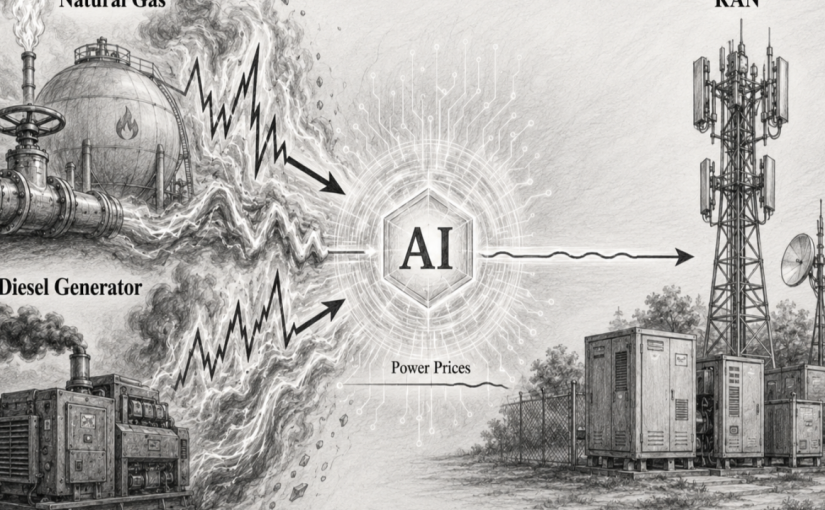
The RAN’s Fossil-Fuel Problem, and AI’s Bill-Killing Answer

Let us contextualize.
The recent conflict in West Asia sent global crude prices on an uninvited stratospheric flight. The impact on global gas prices has been well documented.
Why does this matter for the RAN?
Because crude, and its many children, LNG in particular, still account for a substantial portion of the energy basket in many countries. The push towards green and renewable energy notwithstanding, crude-derived sources continue to account for a meaningful share of global power generation.
There is another, more direct dimension to the RAN’s dependence on fossil fuels.
In countries with unreliable, unstable or absent grid supply, and there are plenty of them, diesel-fed generators, or DG sets as they are commonly called, remain essential to keeping base stations alive.
For a base station, uninterrupted operation is not a luxury. It is the baseline expectation.
Cellular networks have to remain available. The RAN has to keep running. And to keep it running, telcos must continue paying for power sources that are becoming more unreliable, more volatile and more expensive.
Now juxtapose this with the condition of the average telco.
For years, operators have chased the mirage of shorter ROI windows and richer service bouquets promised by every successive generation of mobile telephony. By the time they come to grips with the idiosyncrasies of one generation, the industry is already nudging them toward the next one.
This is where AI enters the frame.
For telcos under pressure, AI is increasingly emerging as a knight in shining armour. Not the ornamental kind, but the useful kind. The kind that brings measurable savings to the table.
The Insight Research Corporation estimates that AI can and is unlocking billions of dollars in 5G RAN power savings in its upcoming report, “AI in RAN: The Ultimate Bill-Killer.”
What makes AI especially powerful is not just one tool, one trick or one algorithm. It is the expanding arsenal of techniques that can act across the RAN stack. AI can drive substantive power savings in the RU, antennas, BBU and orchestration layers such as the RIC and SMO.
More importantly, AI is opening the door for new players to introduce genuine, disruptive innovation in power-saving techniques.
In the face of an adversary that constantly shifts shape, AI becomes the counterbalance: supple, adaptive and quietly deadly.
Interested?
Watch this space.
Published on: August 19, 2026
|

RELATED BLOGS

The ‘Marvellous’ Opening of the AI Accelerator in the 5G RAN

Stakes are high for SD-WAN – Airtel invests in Lavelle Networks