How much does AI actually save? A study of the RU in 5G RAN
Bengaluru, India - 14 November 2026
AI Will Save US$2.6 Billion in 5G Radio Unit Power Costs by 2030, Finds Insight Research
The only report to quantify the real dollar value of power savings delivered by Artificial Intelligence (AI) in the Radio Unit (RU) of 5G networks forecasts a 32.3% Compounded Annual Growth Rate (CAGR) over 2026–2030
The Insight Research Corporation today released How much does AI actually save? A study of the RU in 5G RAN, the only market report that quantifies the real power savings that AI delivers in Fifth Generation (5G) networks. Rather than restating vendor claims or efficiency percentages, the report puts a dollar value on the electricity that AI saves in the RUs of 5G base stations, worldwide, by region and by country.
AI as a net saver of power
Much of the public debate around AI centers on the electricity it consumes. The report brings out the other side of the ledger: in the Radio Access Network (RAN), AI is a net saver of power. It predicts traffic and switches off cells, carriers, Radio Frequency (RF) channels and symbols when they are not needed, puts radios into deeper sleep and tunes transmission power to demand – without compromising the Quality of Experience (QoE). The report details 22 such AI-driven power-saving scenarios in the RU, each illustrated with vendor and operator initiatives.
An enormous opportunity hiding in plain sight
The RAN is the most power-intensive part of a mobile network, and the RU is its largest consumer of energy. Every cell site draws power around the clock, whether or not it carries traffic. The report finds that the RU accounts for roughly half of all AI-driven power savings in the RAN in every country market studied.
Striking diversity across 18 countries
The report's 18 country markets take strikingly different routes to the same goal. China and India together account for nearly half of the 2026 savings, yet growth is fastest in markets as different as India, Japan, Egypt and France. Savings per 5G subscriber shows a wide variance across countries, shaped by each country's spectrum, network density, power tariffs and regulation.
Geopolitics is making matters interesting
The Russia–Ukraine war, tensions in the Strait of Hormuz and the Red Sea, and the aggressive use of tariffs have thrown fuel supply chains into flux and pushed electricity prices up worldwide. Every kilowatt-hour that AI saves in the RU is now worth more. At the same time, the push toward Graphics Processing Unit (GPU)-based AI-RAN architectures could temper the momentum toward lower power consumption – a tension the report factors into its forecast.
A bevy of companies pitching in
The challenge is drawing a wide field of solution providers. The report profiles 52 companies, from RAN Original Equipment Manufacturers (OEMs) and AI-native software vendors to RF semiconductor suppliers, compute platform providers and cloud providers, each with an Insight Research analysis of its relevance to RAN power savings.
About the report
How much does AI actually save? A study of the RU in 5G RAN (November 2026) forecasts AI-driven power savings in 5G RUs over 2026–2030. It covers:
- How AI is applied to the RU, including the role of Open Radio Access Network (O-RAN) and a taxonomy of 22 power-saving scenarios
- Forecasts worldwide and for six regions: Asia Pacific, North America, Europe, the Middle East, Africa and Latin America
- Profiles of 18 country markets: China, the United States, India, Japan, South Korea, Germany, the United Kingdom, Brazil, France, Italy, Indonesia, Spain, Australia, South Africa, Egypt, Saudi Arabia, Canada and Mexico
- The share of the RU in AI-driven RAN power savings and the savings per 5G subscriber in each country
- Profiles of 52 companies, each with an Insight Research analysis
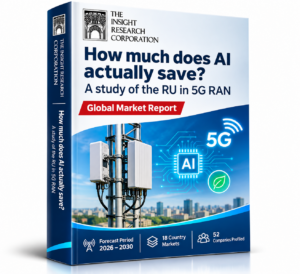
The report is available now at insight-corp.com under Single User, 6-Seat and Unlimited Corporate licenses. Individual reports for each of the 18 country markets are also available.
About Insight Research
The Insight Research Corporation provides in-depth analysis of telecommunications industries and markets, helping clients make the right business decisions at the right time.
MEDIA CONTACT:
Manash Gogoi
Analyst
mgogoi@insight-corp.com
Insight Research Corporation
Bengaluru, India